Government Solar Subsidy 2026: Who Is Eligible & How to Apply in India
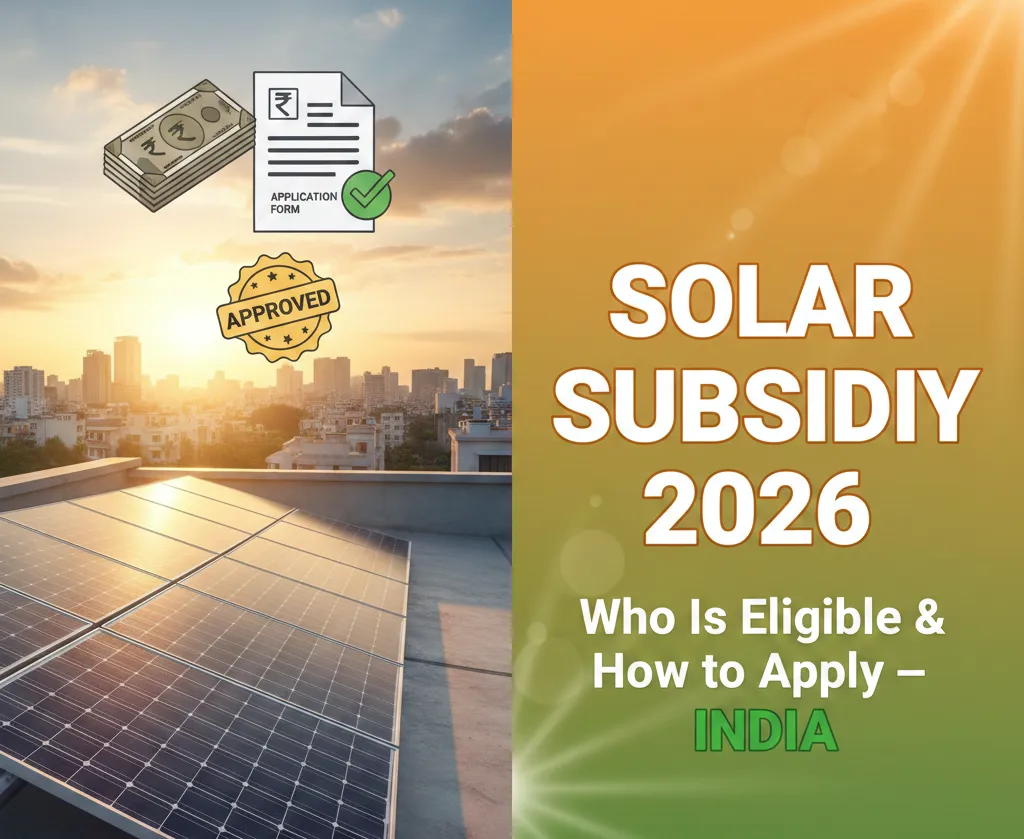
As electricity costs rise across India, rooftop solar has become one of the most cost‑effective ways for households and businesses to generate clean energy. To make solar more affordable, the Government of India continues to support rooftop solar through subsidies and incentives under national and state schemes.
In this 2026 guide, we’ll break down who is eligible for the solar subsidy in India, how much you can get, how to apply, and what the benefits are.
What Is the Solar Subsidy in India?
The solar subsidy is a financial incentive provided by the Government of India — primarily through the Ministry of New and Renewable Energy (MNRE) — to reduce the upfront cost of installing rooftop solar power systems.
The main goal is to encourage adoption of renewable energy, lower dependence on grid electricity, and support India’s climate goals under the Paris Agreement.
How Much Solar Subsidy Is Available in 2026?
In 2026, subsidies vary based on system size and category.
Residential Rooftop Solar Subsidy
Typically available for systems up to 3 kW (with additional slabs for larger systems based on income criteria).
Approximate subsidy (indicative):
- 1 kW system → ₹20,000 – ₹30,000
- 2 kW system → ₹40,000 – ₹55,000
- 3 kW system → ₹60,000 – ₹78,000
Actual amounts may vary by state distribution company (DISCOM) guidelines, local policies, and annual budget provisions.
Other Categories
- Commercial/Industrial systems → Generally receive no direct capital subsidy but benefit from accelerated depreciation and tax incentives.
- Agricultural solar pumps → Subsidies differ and may be higher under separate MNRE agriculture schemes.
Who Is Eligible for the Solar Subsidy?
✅ 1. Residential Consumers
Any household in India can apply for rooftop solar subsidy if:
✔ The solar panels are installed on the rooftop of a residential property
✔ The applicant has an active electricity connection
✔ The system falls within the capacity slabs specified by the local DISCOM scheme
Some states require income criteria for household subsidy slabs — typically targeting middle and lower‑income groups for higher benefits.
✅ 2. Group Housing Societies & Housing Cooperatives
Residents’ Welfare Associations (RWAs) and apartment complexes can apply for rooftop solar subsidy under a collective installation model.
Benefits include:
✔ Shared solar capacity across multiple buildings
✔ Economies of scale – lower cost per kW
✔ Centralized net metering options
✅ 3. Government & Institutional Buildings
Public institutions, schools, colleges, and government offices are often eligible for attractive incentives, tax benefits, and priority support for solar installs.
Who Is Not Eligible?
❌ Landlords who install panels on rented property without a resident’s name on the electricity bill
❌ Installations outside the sanctioned connection point
❌ Systems without net metering approval (in most states)
❌ Unauthorized or unregistered installers
Benefits of the Solar Subsidy
Installing a solar system with subsidy brings several key benefits:
💰 1. Lower Upfront Cost
Subsidy reduces your initial investment substantially, making solar more accessible.
⚡ 2. Faster Payback Period
With high electricity tariffs and net metering credits, many homeowners recover costs within 4–6 years or less.
📈 3. Energy Savings for 20+ Years
After the payback period, the electricity you generate is almost free, leading to thousands of rupees in cumulative savings.
🌍 4. Environment‑Friendly Energy
Solar reduces carbon emissions and dependence on fossil fuel electricity.
How to Apply for Solar Subsidy (Step‑by‑Step)
Here’s a typical application process for residential rooftop solar subsidy in India:
► Step 1: Choose a Reliable Solar Installer
Select an MNRE‑approved vendor or installer with experience in your city. They will help with technical sizing and subsidy paperwork.
► Step 2: Site Survey & Load Assessment
The installer performs:
✔ Rooftop shading analysis
✔ Energy consumption review
✔ System design and capacity recommendation
► Step 3: Prepare Documents
Common required documents include:
✔ Aadhaar Card & PAN
✔ Recent Electricity Bill
✔ Property ownership proof
✔ Passport‑size photos
✔ Bank account details for subsidy credit
✔ System quotation from vendor
Check your local DISCOM portal for exact requirements — they may vary by state.
► Step 4: Apply Through Local DISCOM/Portal
Most states now offer online application portals for rooftop solar subsidy, where you upload documents and submit the request.
Example portals:
- State DISCOM portal
- National Solar Portal (where integrated)
► Step 5: Approval & Net Metering
After verification:
📌 Your subsidy is approved
📌 Net metering application is submitted
📌 System installation scheduled
► Step 6: Installation & Final Inspection
Once installed:
✔ Technical inspection by authorized officer
✔ Net meter installation
✔ Subsidy amount credited to your bank account
Tips for Maximizing Subsidy Benefits
📌 Apply early — annual subsidies may be capped per state
📌 Ensure your installer is government‑approved
📌 Use standardized components to avoid rejection
📌 Track application status on the portal
Important Things to Remember
- Subsidy amounts differ by state and DISCOM policy
- Net metering rules vary across states
- Commercial systems usually don’t get capital subsidy
- Local taxes (GST) may still apply
Final Thoughts
The solar subsidy in India in 2026 makes rooftop solar systems highly affordable for homeowners, housing societies, and institutions. With proper planning, certification, and application, you can significantly cut your power costs and enjoy clean solar energy for decades.
Solar energy isn’t just a smart investment — with government support, it’s now an accessible reality for millions of Indians.