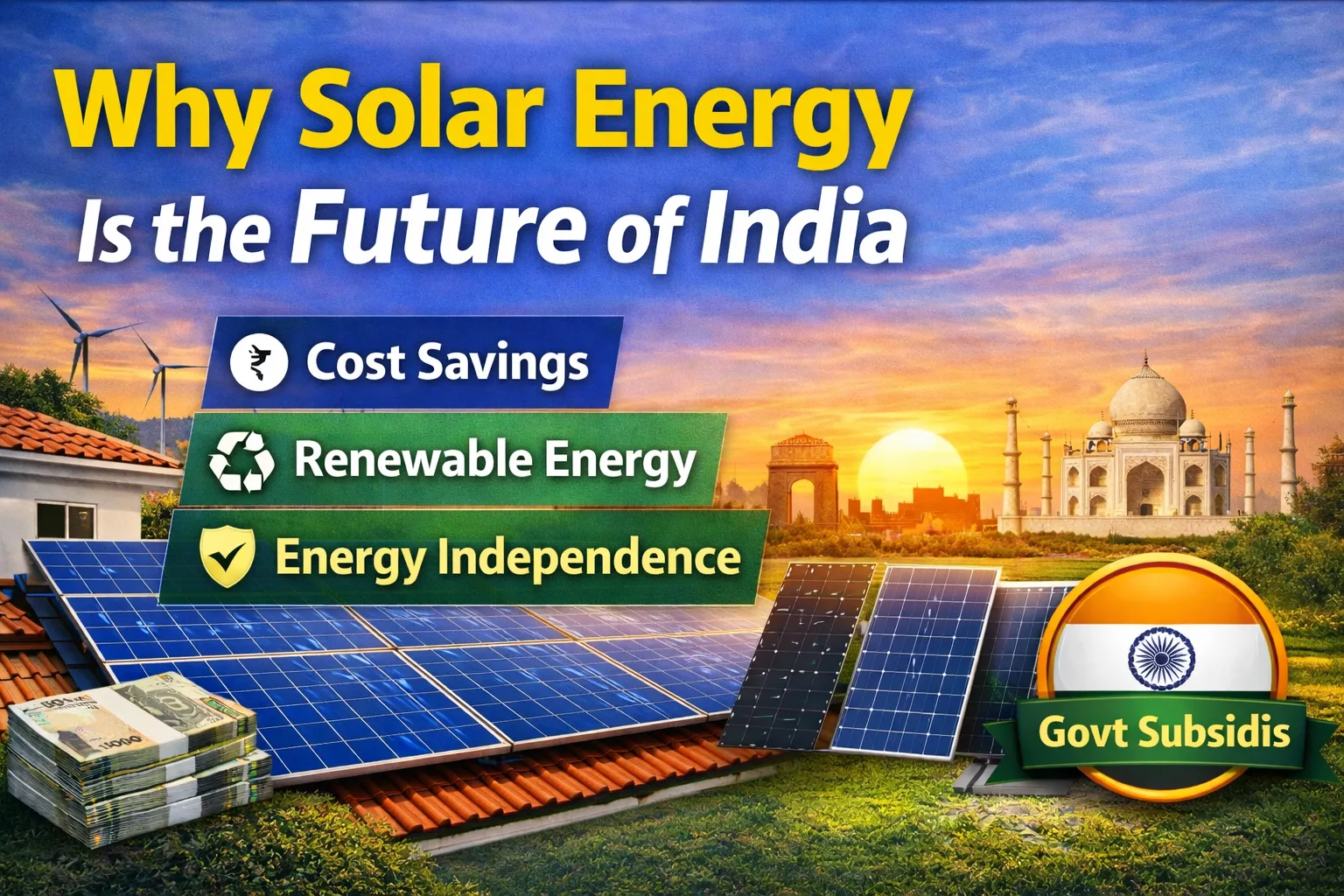
Why Solar Energy Is the Future of India (2026 Guide)
India is standing at a major energy crossroads. With rising electricity demand, increasing pollution levels, and growing climate concerns, the country needs a clean, affordable, and sustainable solution. Solar energy is emerging as that solution. In fact, solar power is not just an alternative anymore — it is rapidly becoming the future of India’s energy landscape.
From residential rooftops to massive solar parks, India is embracing the power of the sun like never before. Let’s explore why solar energy is set to dominate India’s future.
1. India Has Abundant Sunshine
One of the biggest advantages India has is geography. Most parts of the country receive 4–7 kWh per square meter of solar radiation daily. With over 300 sunny days a year in many regions, India has ideal conditions for solar power generation.
States like Rajasthan, Gujarat, Maharashtra, Tamil Nadu, and Telangana are already leveraging this natural advantage. Even northern and northeastern states are seeing rapid growth in rooftop solar installations.
In simple terms, India has unlimited fuel from the sun — and it’s completely free.
2. Rising Electricity Demand
India’s population continues to grow, and so does energy consumption. Urbanization, digital transformation, electric vehicles, and expanding industries are driving electricity demand higher every year.
Traditional power sources like coal and natural gas are limited, expensive, and harmful to the environment. Solar energy provides a scalable solution. It can be installed in:
- Homes (Rooftop solar systems)
- Offices and commercial buildings
- Factories and warehouses
- Agricultural farms
- Large solar parks
This flexibility makes solar energy suitable for both rural and urban India.
3. Government Support & Subsidies
The Indian government is strongly promoting renewable energy. Several schemes and subsidies are available to encourage homeowners and businesses to adopt solar power.
Key initiatives include:
- Rooftop solar subsidies for residential homes
- Net metering policies (earn credits for extra electricity sent to the grid)
- Tax benefits for commercial installations
- Solar pump schemes for farmers
These policies significantly reduce the initial investment cost and improve return on investment.
With simplified application processes and online portals, solar adoption is becoming easier than ever.
4. Major Cost Savings for Households
Electricity bills in India have been steadily increasing. Solar panels help homeowners reduce or even eliminate monthly electricity bills.
Although installing a solar system requires an upfront investment, the payback period is usually 4–6 years. After that, electricity is almost free for the remaining 20–25 years of the panel’s lifespan.
For example:
- A 3kW rooftop solar system can power a medium-sized home.
- A 5kW system can cover most appliances including ACs.
Over time, families can save lakhs of rupees while also increasing property value.
5. Environmentally Sustainable
India faces serious environmental challenges, including air pollution and climate change. Coal-based power plants are one of the major contributors to carbon emissions.
Solar energy:
- Produces zero emissions during operation
- Reduces dependence on fossil fuels
- Helps lower air pollution
- Supports India’s climate commitments
Transitioning to solar power helps India move toward a cleaner, greener future.
6. Energy Independence & Security
India imports a large portion of its fossil fuel requirements. This creates economic pressure and dependency on global markets.
Solar energy reduces this dependency. By generating electricity domestically from sunlight, India strengthens its energy security.
Distributed rooftop systems also reduce pressure on centralized grids, making the power system more resilient during outages and peak demand.
7. Technological Advancements
Solar technology has improved significantly in recent years. Modern panels are:
- More efficient
- More durable
- More affordable
- Better suited for Indian weather conditions
Innovations like bifacial panels, smart inverters, battery storage systems, and AI-based monitoring tools are making solar systems smarter and more efficient.
Battery storage is especially important, allowing homes to use solar power even at night.
8. Employment & Economic Growth
The solar sector is generating thousands of jobs across India. Opportunities exist in:
- Manufacturing
- Installation
- Maintenance
- Engineering
- Sales & distribution
As India aims to become a global manufacturing hub for solar panels, the industry is expected to grow even faster.
This not only supports clean energy but also boosts economic development.
9. Solar for Rural Development
Solar energy is transforming rural India. Off-grid solar systems are providing electricity to remote villages where traditional power infrastructure is difficult to build.
Solar-powered:
- Water pumps
- Street lights
- Schools
- Health centers
are improving quality of life and supporting local development.
10. Long-Term National Vision
India has set ambitious renewable energy targets for the coming years. Solar power plays a central role in achieving these goals.
With increasing investments, policy support, and public awareness, solar energy is expected to dominate India’s energy mix in the next decade.
The future is clearly solar.
Conclusion
Solar energy is not just a trend in India — it is a necessity. With abundant sunlight, strong government support, falling installation costs, and rising electricity demand, solar power is positioned to become the backbone of India’s energy future.
For homeowners, businesses, and industries, switching to solar is both an economic and environmental decision. The sooner India embraces solar energy at scale, the faster it can achieve energy independence, economic growth, and environmental sustainability.
The sun shines for everyone — and in India, it shines with opportunity.